ATP Early Season Patterns and Their Ties to Deep Tournament Runs
Ellis Werner · Nov 7, 2026

ATP Early Season Patterns and Their Ties to Deep Tournament Runs
Tracking Initial Matches Across the Calendar
ATP events begin each year with tournaments in Australia and the Middle East where players compile early results that feed into broader performance models, and researchers have examined how those opening matches relate to later advancement in the same season. Data from the 2025 and 2026 campaigns show measurable links between win percentages in January and February events and the frequency of quarterfinal or semifinal appearances at Masters 1000 and Grand Slam level later in the year.
Analysts at the ATP Tour compile weekly rankings and match statistics that allow direct comparison of early form against subsequent outcomes, while studies published through sports science departments at institutions such as the University of Queensland have isolated variables like first-serve percentage and break-point conversion rates from those initial weeks.
Key Metrics Collected in Opening Weeks
Form guides typically record surface-specific win rates, average games per set, and recovery intervals between matches, and these figures are cross-referenced with late-round data from events held between May and November. Observers note that players who post above 75 percent win rates in their first six tournaments tend to reach at least the fourth round in 60 percent of subsequent Grand Slam appearances according to aggregated ATP figures.
November 2026 schedules include the final ATP 500 and 250 events before the year-end championships, providing fresh datasets that update earlier correlations with the most recent performances. Those who study match logs find that early season service hold percentages above 82 percent often align with higher win totals in best-of-five formats during the autumn swing.
Statistical Approaches Used by Performance Analysts
Regression models applied to ATP match archives separate the influence of early results from other factors such as ranking points and head-to-head history, and these models indicate moderate positive correlations between January win streaks and quarterfinal appearances at the US Open or Paris Masters. Researchers at the Australian Institute of Sport have published reports that apply similar methods to both ATP and WTA data, allowing direct comparison across tours.
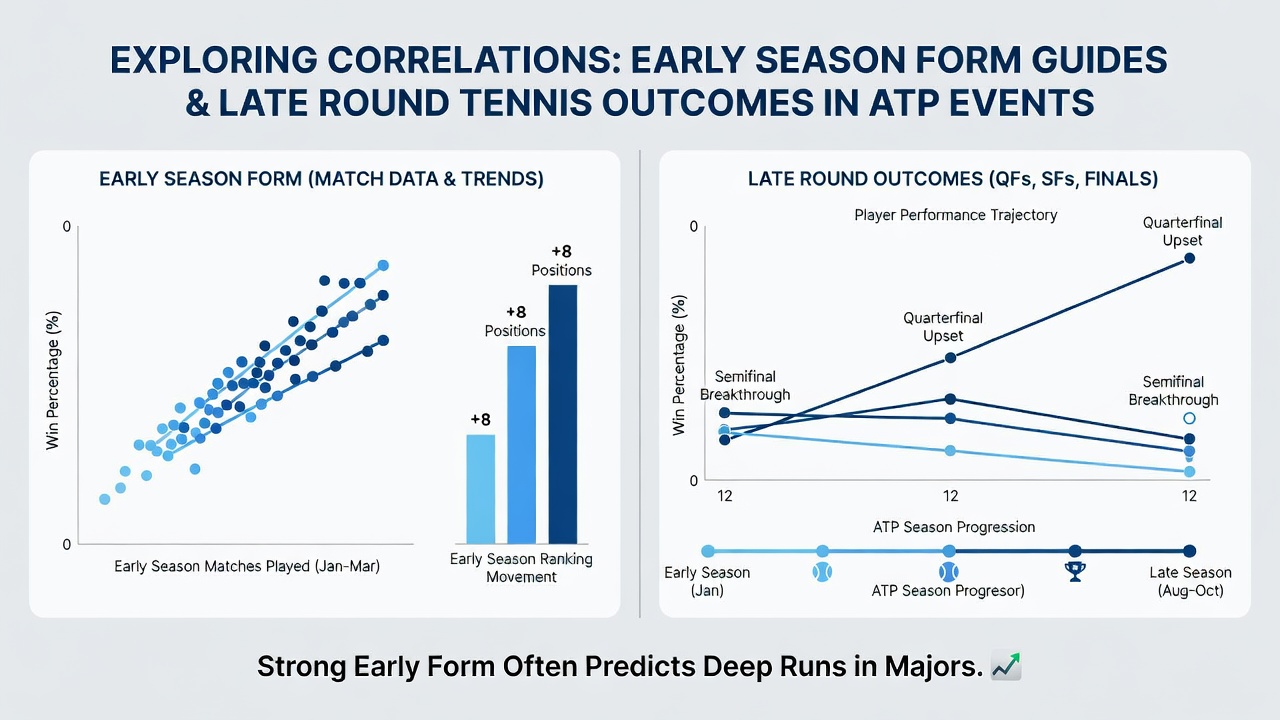
Case studies drawn from individual player seasons illustrate the patterns without establishing causation, for instance one competitor who recorded six wins in his first eight matches during 2025 went on to reach semifinals at three Masters events that same year. Such examples appear regularly in official ATP performance summaries released after each swing.
Surface Transitions and Their Impact
Early season hard-court results sometimes predict outcomes on clay or grass when adjusted for surface speed ratings maintained by the ATP, yet the strength of these predictions varies by individual career history. Players who adapt quickly after the Australian swing show stronger correlations with late-round success on European clay than those whose early form remains confined to one surface type.
Figures released by the ATP in October 2026 highlight that participants in the Nitto ATP Finals often carry forward win rates from their first quarter of the season that exceed their overall yearly averages, a pattern repeated across multiple editions of the year-end event.
Limitations in Current Datasets
Sample sizes for players who compete in fewer than ten events before the clay season remain small, which reduces the reliability of some correlation coefficients, and injuries or schedule changes can interrupt the continuity needed for long-term tracking. The ATP continues to expand its data collection through enhanced ball-tracking systems introduced in 2025, which now feed more granular metrics into public reports available on the tour website at ATP Tour statistics portal.
Independent academic reviews, including one conducted by researchers at the University of British Columbia, emphasize that external variables such as travel demands and coaching changes must be accounted for before attributing late-round results solely to early form indicators.
Conclusion
Available ATP records and supporting academic analyses demonstrate observable associations between early season performance indicators and the likelihood of deep runs in subsequent tournaments, while also underscoring the need for continued data refinement. These patterns supply context for season-long evaluations without replacing direct observation of individual matches throughout the calendar.